
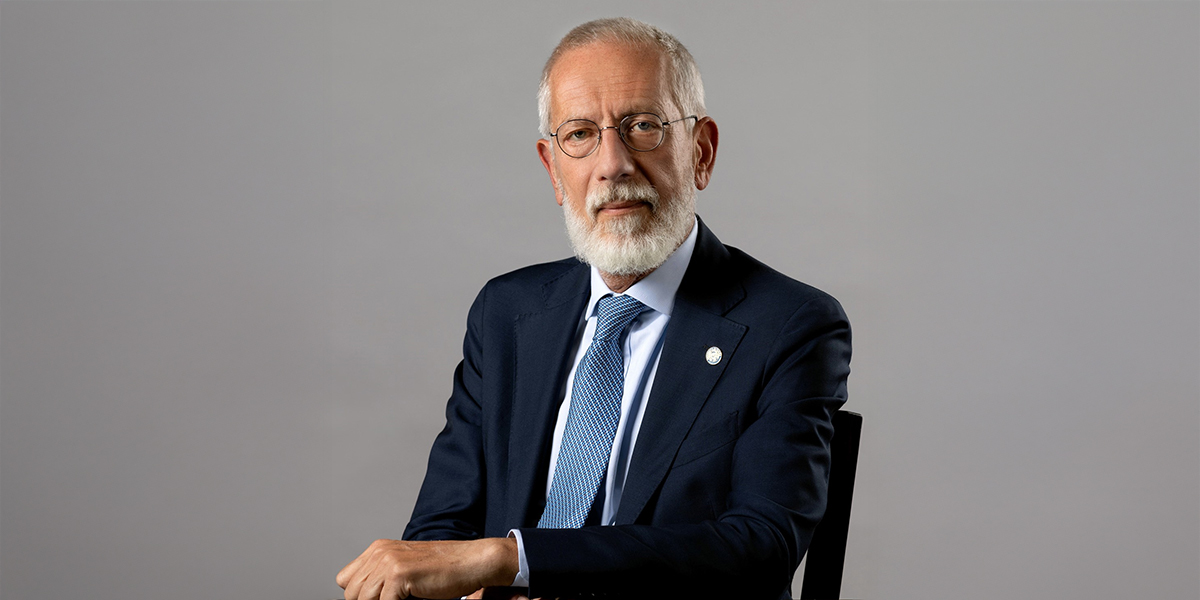
04 Nov Interview with Prof. Paolo Martelli, Rector, University of Parma
How do you evaluate the current state of higher education in the country and what distinctive contribution does the University of Parma offer in shaping its future?
The state of higher education in Italy has some strange statistics. Firstly, the percentage of graduates is not particularly high in Italy. The percentage of graduates between the ages of 25 and 34 is just over 30% and in Emilia-Romagna, it is 32%. We are working hard at the university level to increase this percentage of graduates; it is an average of 43% in the EU so Italy is significantly lower than in other European countries.
We are working hard to increase the number of graduates by being more attractive. The University of Parma is strongly committed to reducing the dispersion and the dropout rate of students during their course of study. We are investing many resources in this through a tutoring program carried out by master’s and PhD students. The Italian system finances the Italian university system, which is not more than 1% of the national GDP. In our region, there is a push on the right to study. This means that students without economic means are still able to study at our state universities. The Emilia-Romagna region guarantees 100% coverage of the right to study, therefore 100% of students who are in need can access funds to study. Last year, the region and the system of regional universities guaranteed the right to study thanks to an investment of €161 million to cover for 100% percent of the students who have the right even if they do not have the financial means, representing about 30,000 students. This makes our universities particularly attractive to students who come from other regions, especially from southern Italy.
The University of Parma attracts 58% of its students from other cities. Parma is third after Bologna and Ferrara to attract students from other cities and regions. The university is attractive because it is ancient and prestigious. Our education has not had interruptions since the school began in 1412. In addition to quality training, we have a very welcoming university city. The university and the municipality are in close collaboration to guarantee attractiveness and hospitality. Many students stay in Parma because the region has great employment opportunities in various industries. The university, the city and the region facilitates access to these opportunities. This strong bond also has potential to open many doors for collaboration.
What measures has the university adopted to promote innovation while safeguarding the institution’s identity and core values?
The University of Parma is a generalist university that embraces all fields of knowledge. The offer spans humanities courses to engineering, mathematics, physics, STEM, medicine and surgery, veterinary medicine and especially agro-food related courses. I would like to highlight the latter as it is an important area of collaboration for our region and the university. For us, innovation is about continually meeting the needs of society, by identifying them and offering training courses that meet the needs of the work world. Our greatest commitment is to upgrade our courses and respond to the actual needs. This innovation is linked to our strong commitment to research. Millions of euros are invested every year, not only to finance the research of our researchers, but above all, for upgrading the equipment, the premises and to provide optimal conditions for the development of research.
Research is financed by the university, by European or regional donors or by private companies. Parma University also benefited from the contribution from the National Resilience Recovery Plan, with extraordinary financing from the European Union. We used these funds for research and innovation of structures and equipment for research.
The university is increasingly recognized for the impact of its research, its collaboration with the local area and a growing international profile. What actions is it taking to further strengthen the university’s global academic standing?
Parma participates and collaborates with the universities in initiatives such as the development of Motor Valley and the University of the Motor Vehicle in Emilia-Romagna. We are particularly interested in transferring this experience to the agro-food sector. MUNER is based in Modena; FOODER is the association created from this university collaboration for agro-food. It is a model shared with four universities that bring together their best resources for high-level international training for Italian and international students from its headquarters in Emilia-Romagna. The region of Emilia-Romagna and the food companies in the region are also part of this association. For example, Barilla conducts training and contributes to innovation and development of new ideas in the field of agro-food. It is a very holistic association of food technology, sustainability and more.
The members are from the main food companies in the region including the consortium of Parmigiano-Reggiano, the industrial unions, Barilla, Amadori and many others. It is certainly a unique model of collaboration amongst universities, the region, the regional institutions and companies on a very interesting project.
How do student services, cultural programs and community events contribute to the university environment? What have been the most recent improvements aimed at enhancing students’ academic and social experience?
The US has attracted students from all over Italy and we are now trying to do the opposite. We are trying to offer our culture, tourism, food, manufacturing and food to the world. FOODER aims to attract students in the food industry. MUNER attracts students because of Ferrari, Lamborghini, Ducati, Dallara and more. Emilia-Romagna is an Italian leader in the food industry, therefore an international agro-food university is very attractive for the University of Parma and the entire region.
Everyone has their own identity and characteristics. If you create a system and a team, it is easier to win. We are electing the president of FOODER very soon. He will most likely come from the industry. The association has existed for four years.
The University of Parma plays a central role in local economic development. How does the university collaborate with the business world to promote applied research, technology transfer and entrepreneurship?
In our organization, we have sectors that deal with the coordination of research activities and technology transfer. This is a constant communication and relationship building activity between the university and the companies and vice versa. It depends on the sector; however, this is not limited to the region. Mechanical technicians are also an important sector in our region including design, production and innovative machinery. At our campus, we have Tecnopolo where we see the strong exchange of technology transfer. We are known for excellence in different disciplines in terms of research, for example, 30 years ago our team of neuroscientists discovered mirror neurons in the premotor cortex of macaque monkeys. It activated a bunch of ongoing studies in the field of neuroscience. It also influenced a wide range of other disciplines. Thus, our university is well known in the field of neuroscience.
If we talk about other areas of strength, I would like to mention mathematics. Cristiana De Filippis joined the University of Parma as a researcher in 2021 and has been an associate professor since 2024. She received the European Mathematical Society prize in 2024 for her outstanding contributions to elliptic regularity and Schauder estimates. I would also like to mention our excellence in quantum science and technologies. Stefano Carretta is a leading figure and professor of quantum science and technologies at our university. He has received many prestigious prizes.
Looking to the future, the University of Parma must continue to evolve without forgetting its roots.What is your long-term vision for the University over the next ten years?
Unfortunately, Italy is in a difficult situation when it comes to young people. It is like this in most of Europe. However, the situation in Italy is very special. In the next twenty years, there will be a significant decline in the younger generation. Our country is aging with fewer young people, so there is a discussion at the university level about the sustainability of the university with fewer young Italians enrolling. The university is at the service of the country. The biggest challenge over the coming years will be to attract international students. We have to inverse what we have been doing from brain drain to brain gain.
To overcome this, our university needs to be more international, attractive, hospitable and inclusive for the students that need what we are equipped with. We are able to give those students the culture and the skills required for a future profession. Those young people will help to move our country forward with their participation in the local economy. I would say this is more like a big responsibility than a challenge. We need to work a lot on the gap that we are going to experience over the next 20 years. I think that internationalization and our offer will help us to overcome this demographic crisis.
What is your final message for the USA Today readers?
The region of Emila-Romagna is very welcoming and inclusive. It can develop and produce in various professional sectors. It is a highly diverse region with great potential. Our students are not guests, but an integral part of the city’s daily life. Our universities are real campuses. The students are the future of this region and country. In 2027, the city of Parma will be the European Youth Capital. Students from all over Europe will come to Parma to experience the lifestyle of the youth in this city. They will have the opportunity to meet and engage in dialogue about different issues. The University of Parma and the municipality are in close collaboration for this year to make it a successful moment for the youth. This is not only for university students but also for younger students as well. Parma has really opened up to this experience of preparing and organizing this event for the youth. This is part of our mission to welcome and be inclusive.
Our students are the future of our city and our country. The University of Parma belongs to a network of nine European Universities called EU Green Alliance. This network helps foster a European spirit that goes beyond Erasmus exchanges. Erasmus promotes a European university experience through exchanges, giving young people the opportunity to move within Europe and gain experience. The network of European universities aims to create a solid European university system. Emilia-Romagna is strong and united.
Sorry, the comment form is closed at this time.