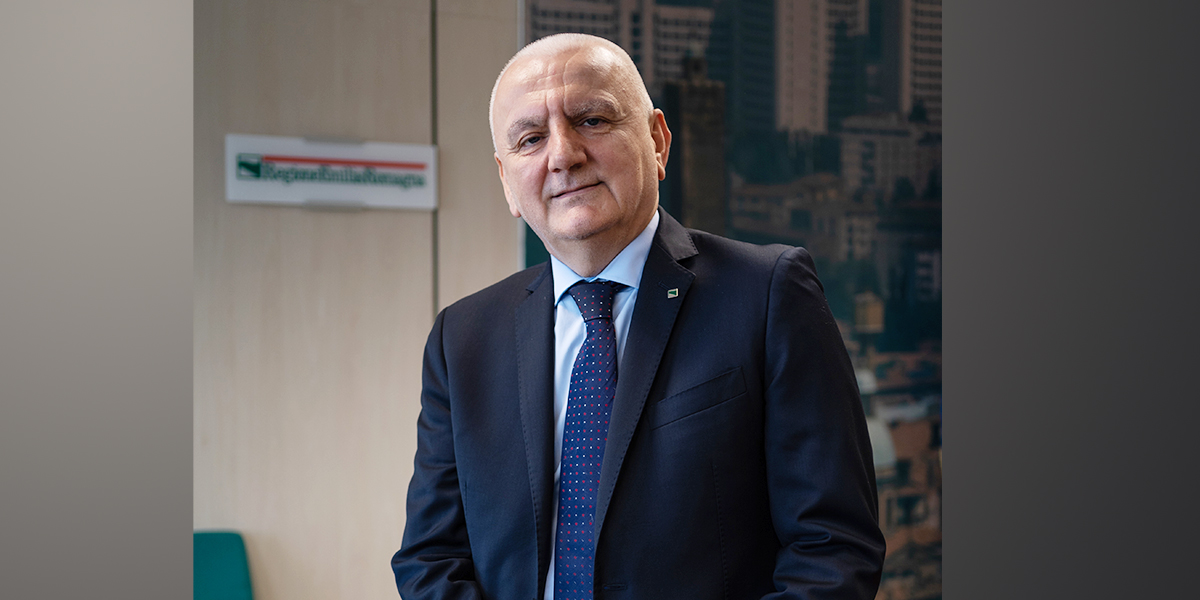
19 Nov Interview with Mr. Vincenzo Colla, Vice President and Councilor of the Emilia-Romagna Region, Italy
BF: What are the key trends shaping Emilia-Romagna’s economic landscape today?
Colla: Emilia-Romagna is fully engaged with the global economy, from geopolitics to innovation. Despite today’s challenges, we remain closely connected to both Europe and the United States through deep historical, economic, and cultural ties. Our strategy is built on three pillars: digitalization, sustainability, and human capital. First, we’re heavily investing in digital infrastructure to boost competitiveness across our 440,000 companies. Second, we focus on sustainability – environmental, social, and financial – but always in tandem with job creation and economic strength. Third, we’re prioritizing education and skills development. This includes major investments in training, universities, and global partnerships. We have long-standing collaborations with leading U.S. institutions like MIT, Columbia, the University of Virginia, and Silicon Valley universities. We’re also expanding ties with Asian universities, including through PhD exchanges, and will showcase these efforts at the Italian Pavilion at the Tokyo Expo. Together, these pillars define the future we are building.
BF: How would you define Emilia-Romagna’s strategic role within the broader Italian economy?
Colla: Emilia-Romagna stands out for producing high-quality, niche products. From gastronomy and packaging to fitness and tourism, our strength lies in combining quality, beauty, identity, and storytelling. This approach has made us the top Italian region for per-capita exports, with over €190 billion in annual revenue, 50% of which comes from exports. We also lead in manufacturing, with global brands and an industrial base that generates €30–40 billion in added value.
BF: With Emilia-Romagna emerging as a European hub for science and technology, what investments and policies are driving this innovation?
Colla: We’ve identified 15 strategic sectors and launched new initiatives in the green and blue economies. A key pillar is our leadership in artificial intelligence. The Bologna Tecnopolo, home to Europe’s most advanced supercomputer for climate research, operates 24/7, processing data on climate, agriculture, mobility, and disaster response. This year, we’re installing one of the world’s largest AI supercomputers – a €500 million investment co-funded by the EU, national government, and our region. It will support SMEs by translating big data into practical, accessible tools. This platform will also be used by the UN University for research on climate change, poverty, and migration, and by the Leonardo AI system to study the social impact of technology on cities. If mismanaged, AI could deepen inequality and destabilize communities. That’s why our approach integrates universities, research centers, and SMEs into one ecosystem. Leonardo is an international project, run by European experts but owned by a Chinese entity, and headquartered in Bologna. Even companies with just 10–15 employees must be part of this technological evolution. Only public institutions can afford these large-scale investments and make them available to SMEs, without compromising their independence or know-how. Treating these companies merely as suppliers would be a strategic error. They must be full partners in innovation.
BF: How is Emilia-Romagna positioning itself to attract global companies?
Colla: Our priority is to retain the companies already here. We’ve recently passed new legislation to attract investment, and several U.S. groups have already benefited. Philip Morris, for example, represents the largest investment, alongside key players in the ceramics and biomedical sectors. At the same time, many of our companies are investing in the U.S., creating mutual value. We believe in taking the “high road” – focusing on quality, reputation, and strong local ties, rather than competing on low-cost production. Our global reach extends beyond the U.S. to markets in India, Europe, Vietnam, and across Asia.
BF: Which sectors offer the most potential for U.S.-Emilia-Romagna collaboration, and what kinds of partnerships are you encouraging?
Colla: We’ve shifted from military to commercial collaboration, focusing on economic investment. One milestone was our agreement with ACTION 3, which led to successful initiatives with NASA. During a mission to Houston, we solidified relationships that resulted in four experiments in orbit. The first, with Barilla, developed food suitable for space missions. The second, with health company GWM, explored remote body monitoring in orbit. Third, luxury automotive firm DALLARA conducted space-based tests on critical materials like carbon fiber and titanium. Space travel challenges open new possibilities for patents and innovation, just as Apollo 11 generated 30,000 game-changing patents. We’re also investing in the Blue Economy, treating water as the “gold of the future.” This includes luxury yachting, sustainable water use in agriculture and industry, and research on purification and reuse. Our universities are collaborating globally through the Tecnopolo. Talent is central to all this. We’re proud to have introduced Italy’s first law focused on attracting and retaining talent by inviting the world’s best minds to work on shared goals. We offer not just opportunity, but hospitality. In Osaka, for example, we’ll present Ferrari, Ducati, Pavarotti, and Verdi, because showcasing Italian culture is part of how we connect with the world.
BF: How are sustainability priorities influencing economic and political decisions in Emilia-Romagna?
Colla: Our approach is guided by global frameworks like the UN Agenda 2030, COP21, and Laudato Si. We believe that combining sustainability with high-quality production enhances reputation and attracts the next generation. We’ve secured €4 billion in EU funding and are directing it toward digitalization and sustainable production in a circular economy. Current investments focus on green mobility, including hydrogen-powered public transport, electrified rail, and electric vehicles. Ferrari and Ducati are developing recyclable battery technologies. While embracing innovation, we’re also balancing tradition. That includes exploring clean gas technologies, next-gen nuclear with ENEA and NUCLEO in Brasimone, and large-scale CO₂ capture projects in partnership with ENI and SNAM – part of Europe’s largest initiative in Ravenna. Our regional energy plan promotes a hybrid model: local, diversified production using solar, wind, and storage. To avoid issues like recent solar shutdowns in Spain due to a lack of storage, we now require all photovoltaic projects to include built-in storage solutions.
BF: Do you have a final message for our American investors and business leaders about choosing Emilia-Romagna as their next destination for travel and investment?
Colla: We believe peace and liberal democracy are the foundations of any thriving economy. They define the West’s history, identity, and quality of life. Upholding these values is essential – not only for prosperity, but for the common good.
Sorry, the comment form is closed at this time.