
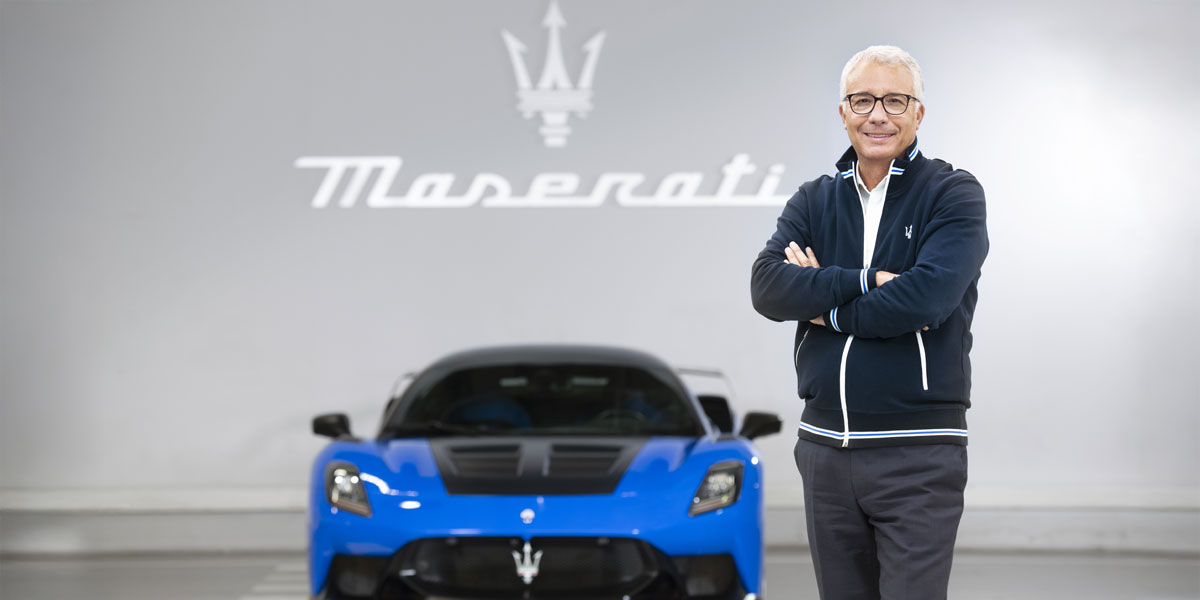
09 Nov Interview with Santo Ficili, Chief Operating Officer, Maserati and CEO, Alfa Romeo Stellantis
Maserati has opened a new chapter with the launch of the all-electric Folgore range, starting with the GranTurismo, GranCabrio and Grecale models. How have these new vehicles been received and in what way are these models shaping the brand’s future?
We are one of the few brands offering a product at this level — a fully electric, high-performance vehicle. The GranCabrio, which is the convertible version of the GranTurismo, is the only four-seater, fully electric model on the market. Its performance is outstanding. Naturally, we tailor our response to the specific needs of customers worldwide. The GranTurismo, GranCabrio, and Grecale Folgore are designed to meet the expectations of clients seeking a luxury, electric sports car. The technology behind them is truly cutting-edge.
The main challenge is to be able to respond to the needs of our global customers in an ever-changing world. The recent transition is not in line with what one could imagine a few months ago. Today, customers have many doubts about how to approach this electric product. We rely on our sales network and our dealerships. They must be able to express and explain to the customer about the qualities of the product in relation to their requirements.
Thanks to Stellantis, Maserati benefits from its global scale and cutting-edge technologies. At the same time, there is a risk it could lose visibility within a larger corporate structure dominated by crossovers and shared platforms. How do you ensure that Maserati maintains its independence and identity within a group that includes 14 brands?
Stellantis includes 14 brands, covering both commercial vehicles and passenger cars. This gives us strong foundations, especially from a financial and structural point of view. It takes strength and long-term stability to support everything we do in the luxury segment. Maserati is the only true luxury brand within Stellantis. It has its own dedicated management team. It is the same for our premium brand, Alfa Romeo. It also has strategies adapted to the needs of our customers.
Our core strength is being 100% Made in Italy. We produce exclusively in Italy, which reinforces our identity. Of course, evolving trade policies and increasing duties — particularly in key markets like the US — present challenges. But we remain firmly committed to preserving Maserati’s handcrafted, Italian character while leveraging the strengths of the group.
The company has relied on McKinsey & Co for guidance on how to navigate the new US political landscape. How are you adapting your strategy based on different markets, particularly in the US?
The Maserati brand is the global brand of our company. The North American market, in particular the United States, is a continent and a market. The US is fundamental and strategic for the company. We make about 30% of our sales in North America. The launch of the tariffs has destabilized the market, but they have been consolidated, with a clear idea of the imposed taxation which will stabilize the market. I believe in the next few weeks, the situation will be more stable. The increase is about 15% but remember it impacts the entire American market and not only Maserati.
The luxury car segment is highly competitive, with electrification and digitalization defining new areas of challenge. What is Maserati’s long-term vision as it competes with Tesla, Porsche and even “sister” brands like Alfa Romeo? Will future electric models include stylistic references to the brand’s heritage, or is the aim to have a clean break with a bold new look?
There is no competition between Maserati and Alfa Romeo. Alfa Romeo is part of the premium market, with a lineup ranging from compact crossovers to high-performance models. It occupies a space rooted in Italian identity, performance, and emotion, symbolized by the color red, the lifeblood of Alfa Romeo.
Maserati, by contrast, is positioned in the luxury segment. It is about the ability to craft elegant vehicles that celebrate touring and the sheer pleasure of driving. Maserati is an artisanal product. Our electric model, Folgore, delivers high performance, while the Nettuno engine, a fantastic and versatile V6, powers other models. I manage two global brands. Each has a rich history and strong legacy, even if they are not entirely distinct. Alfa Romeo has existed for 115 years and Maserati for 110 years. We have passionate clients for both. The two brands attract different customers.
I do not view them as competitors in terms of model or brand. We started with each brand’s unique heritage and built towards the future. For example, the latest entry in the B-SUV segment strengthens Alfa Romeo’s competitiveness, while high-performance models continue to reflect the brand’s DNA through design and engineering excellence.
Alfa Romeo remains one of the most evocative names in automotive history, known for its design, engineering and Italian soul. However, the brand has struggled to maintain consistent relevance and sales. It has captured the hearts of enthusiasts, but commercial success has lacked stability. What are your current priorities for making Alfa not only iconic, but also profitable and sustainable?
I am extremely satisfied with Alfa Romeo’s performance. We have achieved 20% growth to date compared to last year. We have done amazing work on the product. Our dealers are also doing very well in the locations where we sell cars. The Junior has 45,000 orders. This was beyond our expectations. The market responded well to this car, even the electric model. The Alfa Romeo Tonale continues to perform very well. We also have the Giulia and Stelvio. They are two wonderful cars in terms of handling, performance and comfort. Even though they are no longer brand new models, they are delivering solid commercial results.
I can say all of this because I really believe in the product. The B-SUV segment is growing. As I mentioned, the Junior is performing very well and is the right car for this category. For the Tonale, we are focused on the C-SUV segment, which has significant growth potential. We are seeing strong performance in Europe. The Tonale is also doing well in the US and in other markets where we operate while the Giulia and Stelvio remain our cornerstones in Italy. They are achieving solid results internationally as well. I would also like to highlight that the Quadrifoglio Verde models, the high-performance variants of both the Giulia and Stelvio are particularly well regarded in Japan.
What kind of road shows or conferences do you attend to increase sales?
We have very strong marketing plans. We presented the MCPura at Goodwood. The previous MC20 was already an excellent car. We worked very hard on those small details that made them feel they could improve further. Today, the MCPura is a fantastic car. The public responded positively at Goodwood. It has high visibility on the internet. Our marketing team has prepared numerous product presentations.
Some latest news for your readers is the Maserati GranTurismo and the GranCabrio, which were produced until now in Mirafiori, Turin will move to Modena. Mirafiori will produce the hybrid Fiat 500 and the electric Fiat 500. The Turin plant is perfect for that type of production. Maserati’s home is Modena. In September and October, we will do a relaunch of these two cars. Massimo Mezzetti, Mayor of Modena, is a good friend. We will plan to do an activity here involving the municipality and the region of Emilia-Romagna with Michele De Pasquale. We are bringing these two cars to Motor Valley, which is located in Modena.
How do you work with universities like Motor Valley University to keep the next generations interested in cars and car production?
We are always involved and available when the university calls us to come and represent our work. Turin is at the end of the Motor Valley because it is located at the end of the Po River Valley. Modena is in the center of the Po River Valley and near the Motor Valley. It is wonderful to be with everyone else. They are not competitors – Pagani, Dallara, Lamborghini and Ducati. A part of the population is linked to motorsport, to cars of a certain level and to prestigious cars. We are honored to be in Modena. All of the energy is concentrated in this one place. You can feel the presence of the automotive industry.
The factories in Mirafiori, Turin have always manufactured large volumes of cars. Modena has a history of luxury products. The city has it in its veins. You can breathe luxury in the air. Our talented people are passionate about Maserati. Alfa Romeo and Maserati have clubs worldwide — our classic cars are our heritage — and they have followers throughout the world. In the US and globally, thousands of people are passionate about Maserati and Alfa Romeo. For this reason, in Modena, we have Maserati offices, which are a structure dedicated to certifying, supplying spare parts and repairing. It is beautiful to know that people all over the world trust us with these jewels.
In my opinion, when I look back at the history, I feel that these cars are a work of art. Our archives contain all of the drawings that we have produced over time. If we have a customer who needs to personalize the car with particular colors and interiors, a team of professionals works on that following the Maserati DNA.
The shift to electric is transforming the entire industry, but timelines are being extended. Alfa Romeo originally planned to go fully electric by 2027, however, it is now pursuing a “multi-energy” strategy, offering gasoline, plug-in hybrid and electric models. What will it feel like to drive an electric Alfa? How will the brand’s distinctive character be preserved?
An electric Alfa Romeo will still feel like an Alfa Romeo — emotional, dynamic, and performance- driven. That’s our priority. We are ensuring the electric versions deliver a driving experience aligned with our DNA.
With our Junior Elettrica, we have managed to migrate all the qualities such as the driving experience of an Alfa Romeo. We are here to satisfy our customers. There is going to be an ongoing transition towards electric cars, but in the current phase of transition, we cannot say only electric because the customer asks for other types such as powertrains, power supplies and engines. Therefore, we can offer electric cars, plug-in hybrid cars with the charging plug and classic endothermic engines and mild-hybrid power supplies. This is the first level of hybridization. Alfa Romeo and Maserati offer all of this because the customer requests it. The company is committed to reducing the emission levels of thermal engines. The engines will also respect the environment. Our aim is to find the right answer for the customer.
What is your final message about one or both brands for the readers of USA Today?
I am honored to lead these two wonderful brands. We are building our future with our unique story and heritage. The story, as I said before, is about our roots, which are very strong, unique and from which we build our future. The red heart of Alfa Romeo remains passionate, sporty and emotionally connected to its customers—just like our partnerships with Italian excellence in sport, from Jasmine Paolini to Luna Rossa. We have customers that are in love with this fantastic brand.
On the other hand, the luxury brand, Maserati, is unique within Stellantis. The vehicle is Italian from the design to the production. It is an Italian product made in Italy. We can personalize Maserati for our clients. Both of our brands are rooted in a wonderful company history. To the USA Today readers: thank you for your passion. Whether it’s Alfa or Maserati, we’re proud to share a piece of Italy with you.
Sorry, the comment form is closed at this time.