
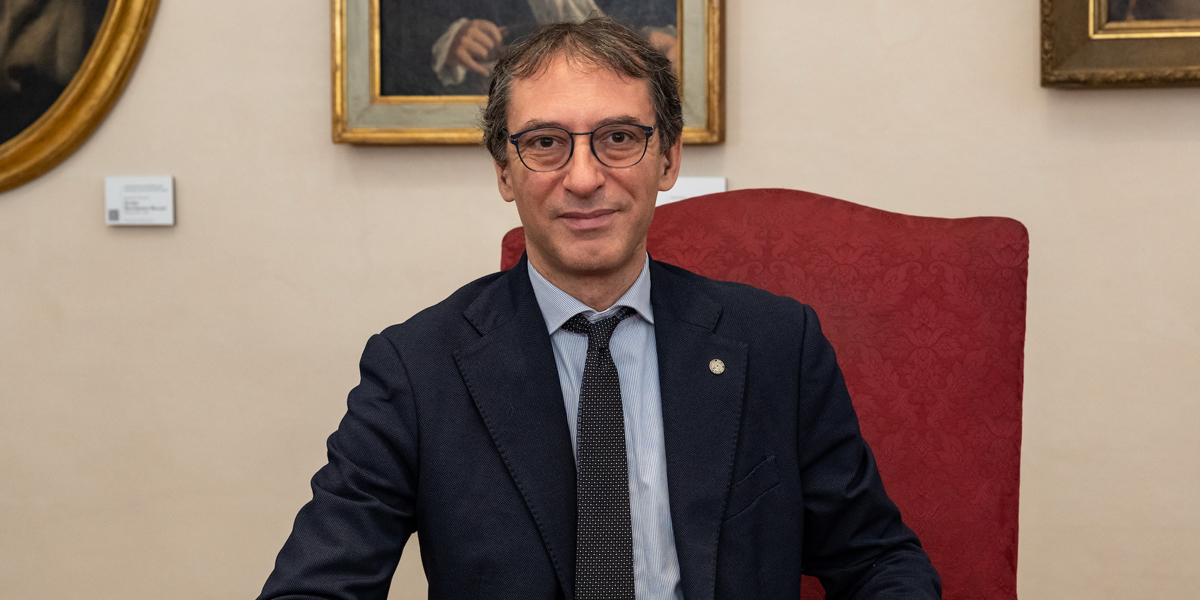
03 Nov Interview with Prof. Giovanni Molari, Rector, University of Bologna
As rector of the University of Bologna, the oldest university in the western world, how do you view the current state of higher education in Italy and what unique role does your institution play in shaping its future?
We are strongly committed to developing double and joint degree programs in Europe. We belong to an alliance of 11 universities and run programs like our European Studies degree, which lets students enroll across four countries and study at partner universities such as Madrid, Krakow, Bologna, the Sorbonne and Zurich.
Unlike Erasmus, these students are fully enrolled in multiple institutions and move freely during their three-year degree. We also focus on lifelong learning and internships with companies. In recent years, we have greatly increased our PhD positions, many funded through the recovery plan and industry partnerships. Currently, we have about 800 PhD students each year, many working closely with companies to strengthen ties between the university and the region.
Could you highlight the university’s recent efforts to strengthen its global research profile and enhance academic excellence?
The University of Bologna is one of Italy’s largest universities, with around 100,000 students. Our main campus is in Bologna, but we also have campuses in Rimini, Forlì, Ravenna and Cesena. We have 31 departments covering all disciplines, with 3,500 professors and the same number of staff. In recent years, we have invested heavily in infrastructure and laboratories, supported by the recovery plan and in collaboration with companies.
Another priority has been strengthening partnerships with leading universities worldwide. About half of our degree programs are offered in English or as double or multiple degrees. Internationalization is key for us — last year we saw a 25% increase in international students, who now make up over 10% of our student body, a significant rise for both our university and Italy as a whole. Strengthening international connections is also essential for accessing international grants. For this reason, I recently visited several universities in the University of California system to expand our partnerships. We already welcome many students from US universities — currently, we have 250 students on exchange and 280 US students studying with us in Bologna. The US, like Japan, is a key partner for us and I aim to build stronger cooperation between the US, Japan and Italy to create more research opportunities.
How do you sustain innovation while preserving the institution’s heritage?
Innovation is essential for us, as the University of Bologna’s 937-year history depends on constant renewal. To maintain our global standing, we must continually update our programs and skills to match the needs of a changing job market. We focus on aligning our courses with industry demands and new technologies, working closely with companies through joint labs and partnerships, for example, with Ferrari and NXP on electric batteries. Attracting top professors from around the world is also a priority. Despite mobility challenges, we believe increasing international exchange is the best way to stay connected and competitive.
The University of Bologna is one of the most globally connected institutions in Europe. What factors contribute to the university’s appeal abroad and how do you foster long-term academic ties with global partners?
We belong to several international networks, such as the Guild, the Coimbra Group and the Magna Carta Observatory, which was founded by the University of Bologna. In recent years, we have signed new agreements with universities worldwide, including in Central Asia, the USA, Japan and beyond. We are Europe’s top university for Erasmus mobility, with about 3,500 students coming in and going out each year.
We also host many US students — about 250 annually — and some US universities even have offices in Bologna to support this exchange. To reach more students globally, we now offer degree information and orientation not only in English but also in Spanish, especially for Latin America, and we have many students from Asia too. Providing guidance in multiple languages is a key part of our strategy.
How is the University of Bologna continuing to lead in student exchange and international academic cooperation today?
Our main goal is to increase our internationalization, which is still a challenge in Italy. One way to do this is by showcasing and sharing our facilities and labs, many of which are unique. For example, instead of duplicating expensive infrastructure, we collaborate with top facilities worldwide — like the Wilfley table I visited in California — and welcome international professors to use ours. In the last two years of my term, I want to expand this exchange even more, encouraging greater sharing of research facilities globally.
Many exciting developments are happening here in Emilia-Romagna, home to unique facilities that cannot be easily replicated elsewhere, so sharing them is key. For example, we have agreements with companies like Dallara, giving students access to state-of-the-art labs while companies benefit from skilled graduates. Our students are very active: our team recently won the Monaco electric boat race and Bologna is hosting the European University Basketball Championship this year. We believe sports and sustainability go hand in hand with academics.
Many student-led competitions focus on clean technologies, like electric engines powered by renewables. The University of Bologna offers countless opportunities across disciplines — from engineering and medicine to humanities, social sciences, agriculture, veterinary medicine and the arts.
Is AI a challenge or a useful tool for your students? Do you see it as something to work with or a threat to their future?
We approach AI use at the University of Bologna with clear rules and guidelines to ensure it is used responsibly. We run workshops and seminars to help professors and students understand AI’s potential and proper use. AI is already part of our administration and we encourage students to use it within our guidelines. We also offer a dedicated degree in AI and have an interdisciplinary AI center that brings together experts from different fields. We aim to integrate AI not just in teaching and research but also in university management.
What is your long-term vision for the university over the next decade and how do you plan to ensure its continued leadership in European and global academia?
Our main goal is to become more connected and international. This means using tools like microcredentials and shared systems to make joint degrees easier, exchanging curricula, credits and using common languages and processes. Another priority is creating more interdisciplinary programs and bringing more innovation and technology, including AI, into teaching. These are key steps for our future.
Our university ranks around 150th in the world but rankings often penalize large student numbers. With 100,000 students, our professor-to-student ratio is lower than in US universities. Being a large, comprehensive and open university affects our ranking position.
What is your final Message to the readers of USA Today?
The University of Bologna is truly international today. We have invested in new infrastructure and opportunities, making our university attractive to students worldwide. Italy is changing and we hope more national students realize they can study here. While challenges exist globally, these also create opportunities for us to share expertise and welcome more international students. We work closely with US universities and Italy can be a hub for collaboration. It’s important to have agreements that allow their researchers to work here without necessarily relocating. While our facilities are improving, some areas still lag behind top global universities. Sharing expertise is key to closing this gap.
Sorry, the comment form is closed at this time.