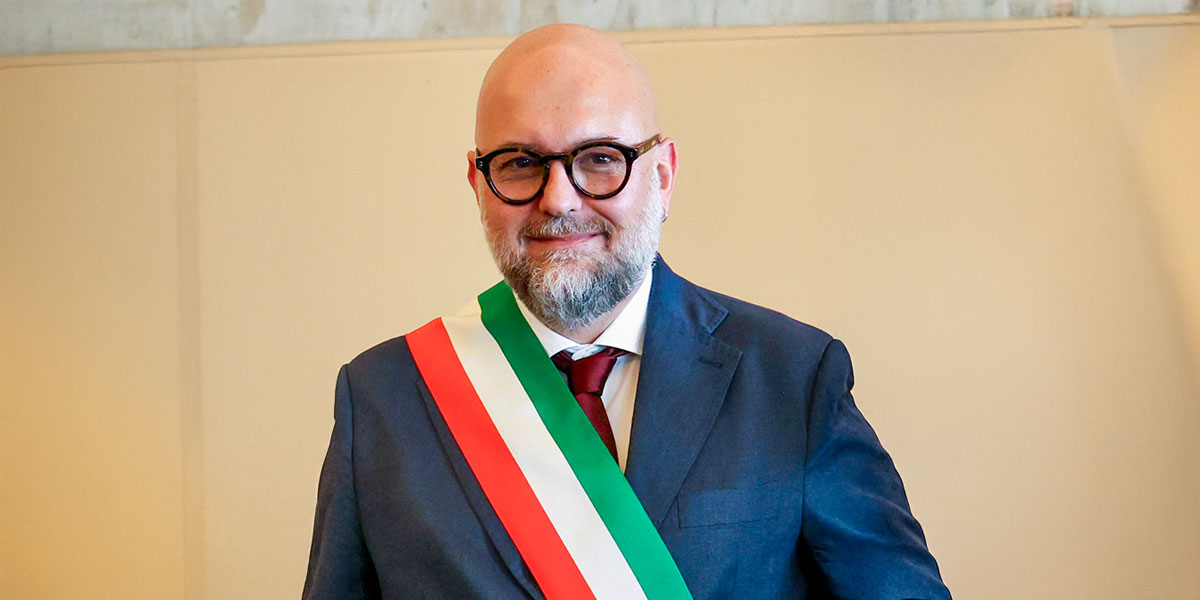
15 Nov Interview with Massimo Mezzetti, Mayor of Modena
What are your plans for the future of Modena? What are the challenges you face and what are your goals for the first year in office as Mayor?
Since I became mayor, I have been looking closely at some fundamental policies. I recognize that we must pay attention to our most fragile citizens not only related to social conditions but also health. In particular, we want to pay special attention to the elderly, who are often the loneliest people in our city. I believe 35% of the over-74s in Modena live alone. This refers to their daily life, loneliness, insecurities, fears about transformations in the city and the phenomena of immigration. I want to mention that also the youth, especially after the period of the pandemic, experience the problem of loneliness. This loneliness has led to aggressiveness and resentment towards their peers. We need to be attentive to all who live in a condition of economic difficulty, which is increasingly growing.
Modena’s statistics demonstrate that the wealth index is growing. At the same time, the social wound continues to open up more and more. This means that the rich have become richer and the poor have become poorer. The latest statistics indicate that about 23% of Italians, including the inhabitants of Modena, who have slipped into the poverty line, have a stable job, but the wage conditions no longer allow them to keep up their expenses. In 1999, the year before the euro, a person who earned three million lira lived well and put money aside. Today, the equivalent is €1500. This is not considered the poverty threshold, but rather a grey area that sets off a warning. Our community aims to pay attention to development and economic growth, but without abandoning anyone along the way.
We need to improve social services and health services. The local municipalities are the cardinal point of this country as they are the closest to the citizens. We often joke that it is always the mayor’s fault because they come to us for everything. It is not only the mayor’s responsibility but also that of the state, the region and even Europe. We need to leverage taxes to be able to go in the direction of helping in need. This means reducing or canceling for those under a certain income threshold and increasing for those who can afford it. We need to maintain this strong social cohesion.
If we want to be an attractive city, we need to face the issue of over-tourism, which very often destroys the identity of the cities, especially the historical centers. Although tourism brings economic benefits, it must be controlled with intelligence and find a balance with the everyday life of the city. The housing shortage is a huge problem: if an apartment cannot be found for under €1000 per month, how can the average public employee manage to live? The housing issue is another central theme that we tackled during our first year.
We are investing in making culture a fundamental element of the growth and development of our community. It is the central nerve, which builds our identity. We are sensitive to the different cultures in our community. Integration and sharing between different cultures will become an element of collective growth. On another note, we faced serious problems this year in the management of waste collection to favor the protection of the environment. The theme of urban planning is also important for us. Urban planning is about the houses we build, where we build them and how we build them. It is about public mobility, social places and meeting places. This needs to take into account that the citizen is at the center of the project.
You have long been a promoter of culture as a form of civic identity and have implemented the Intercultural Cities Program, valuing diversity as a resource for society. How does your cultural vision influence your current project for Modena?
I am convinced that culture is not a list of activities. Culture is everything that contributes to the development of the identity of a community. Culture is food and the way we eat; culture is a business idea consisting of invention and creativity; culture is theater, music and cinema; culture permeates our daily life. It is about cultivating beauty, which is similar to cultivating kinder relationships. Culture helps us to form social relations, conditioning contributes to making our relationships more beautiful. I used kindness in my campaign. I believe that culture helps us in this direction. Those who are cultivated, not with academic degrees, but because of feeding on culture every day, can become stronger and affirm their ideas.
Modena is both an industrial hub and a cultural gem. The automotive industry is the most well-known. Earlier this year, an increase in Maserati production in the city was announced. There seems to be no shortage of food, churches, palaces and a strong sporting tradition. How do you reconcile economic development, quality of life and sustainability?
We have a strong automotive industry and the biggest automotive and motorcycle brands are between Modena and Bologna. Everyone knows that food is also one of our strengths — Modena has 23 protected designations of origin. All this originates from a great ability of those who have been able to carry on this tradition and to innovate it. I also believe that creativity plays an important role.
In addition to the famous brands, we have Pagani, a brand that makes cars worth millions of euros. In industry, we are strong in production but also in supplying the products. Made in Italy is about buying the name and the quality product. There is something emotional about this. This is part of our history from the Renaissance period to the present. Leonardo da Vinci was the ultimate expression of expertise and genius. Of course, not all of our citizens are Leonardo, but we have a long-standing cultural training. This added value makes many foreign and American tourists come here. This year’s tourists well exceeded that of Bologna yet our population is a third of Bologna.
Considering your experience in art and cinema, particularly with the Biografilm Festival, how do you envision Modena’s contribution to Italy’s cultural and creative economy? Are there ongoing initiatives to attract the film industry, media or creative sectors?
For about ten years, I was the regional councilor for the Emilia-Romagna region. Regulations for the cinema industry and participation in the film commission, which attracts national and international productions, were some of my initiatives. Now that I am mayor, I will continue to make use of this experience and bring opportunities to Modena. We want to see growth in this area for Modena. Several film productions have been made and are currently being filmed in Modena, thanks to the work of the Emilia-Romagna Film Commission. We also invest a lot in theatrical activities, not only public, but also private, such as youth companies that develop research in theater. Modena is a leading city for the theater with the Emilia-Romagna Theater Foundation, the National Theater and the Pavarotti Theater.
What role do you envision for young people in the future of Modena? Are there already specific programs active for youth inclusion or civic education?
Unfortunately, young people are not the majority population of the city. We are experiencing a decline compared to an increase in the elderly population. We would like to invest more in education. With the city of Reggio Emilia, we have a strong education from ages zero to six. There is a tradition of public investment in training for the youngest through high school years and Modena has one of the largest offerings in terms of sports facilities in Italy. The youth are very active in the associations and voluntary activities and they are also part of Catholic and secular associations.
The municipality has many active projects for young people. However, I would like to emphasize that in this first year of my term we faced a particularly delicate situation related to the phenomenon of violence among adolescents. There have been assaults that have greatly alarmed parents and public opinion more broadly. We observed that these assaults rarely had a predatory intent — not to justify them — but to provide context for understanding. It is necessary to work extensively with this age group. We decided to create a task force among councilors involved in various capacities from education to culture, social services to security. This task force is focused on youth issues.
What are the most famous products from your region and in your city?
Balsamic vinegar is our black gold because it needs particular care. It is a tradition that is produced in a wine mill and has a long process. The more it ages the better it is. This is not the industrial balsamic vinegar from a supermarket. The traditional product is balsamic cream and aged. Just a few drops on salads, strawberries, ice cream and with parmesan is the perfect pairing. This is a family artisanal product sold for generations. The barrels need the right climatic conditions for aging. A few drops can cost €100.
Parmigiano Reggiano joins with balsamic vinegar as the leading food products of our region. Our wine, Lambrusco, is also exported. We also have a variety of olive oil products and salt from Ravenna.
What are the investment opportunities for the United States in your city?
We are open to considering all types of investments. We already have many important ones. We have a technology innovation hub called CBC. Two years ago, it was acquired 100% by Mitsubishi. They produced the entire product range of the Amazon autonomous taxi. It will be used in the United States. In Italy, it is not authorized yet.
Nevertheless, we are waiting for you with open arms. We have natural and cultural treasures, entrepreneurial Made in Italy and amazing food products. There are a lot of opportunities for the future.
Sorry, the comment form is closed at this time.