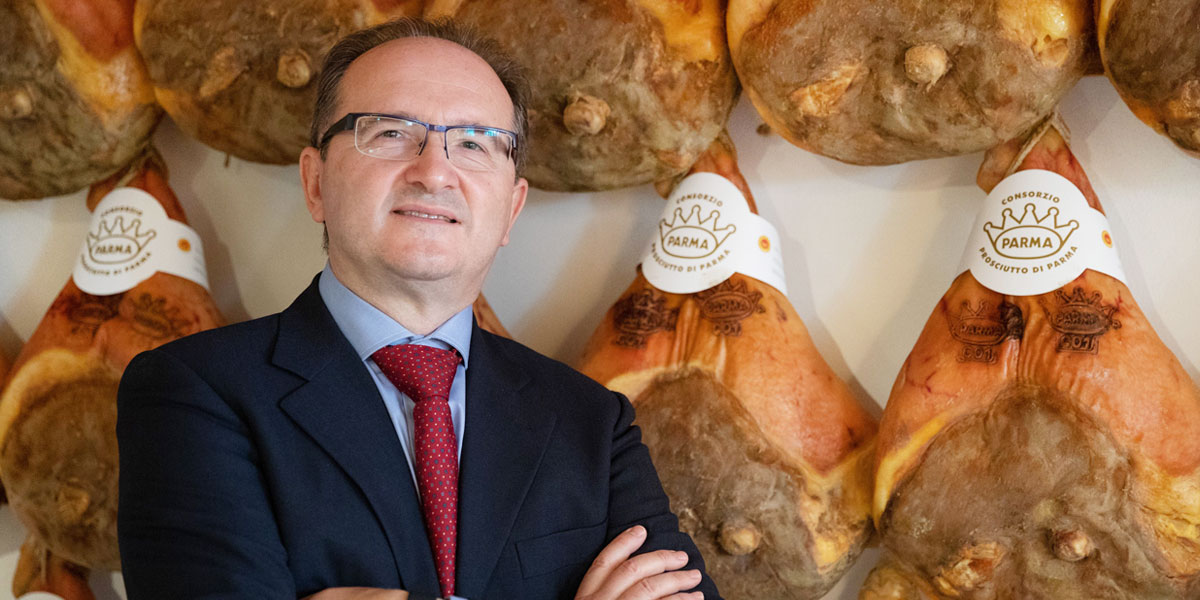
25 Oct Interview with Alessandro Utini, President Prosciutto di Parma Consortium
The Consortium recently celebrated more than 60 years of activity. How has its mission evolved from 1963 to today and how do you preserve the historical legacy while adapting to the global food economy?
In 1963, 23 producers founded the consortium based on the need to protect Italian gastronomic specialties. Initially, it was voluntary and with a goal to unite the forces and resources to protect and promote the Italian products. Today, the consortium brings together 127 companies. In a broader context the world has changed however the priorities and the mission have always remained the same. Both the name and the brand require protection. Parma ham is exported to more than 90 countries worldwide. We have extensive communication activities to promote the product in Italy and abroad. We are always looking at opening new markets abroad as well as developing the domestic market. The mission is always to strengthen to protect the name and make it known more and more all over the world.
Parma ham (prosciutto di Parma) enjoys PDO status in both Europe and abroad. How do you ensure this and the enforcement of this status globally, in the face of imitations and improper uses?
The protection of the product is obviously our main task. The denomination of protected origin is a European standard. It enables us to protect Parma ham in all of the 27 countries of the European Union. Many countries in the world do not recognize this system of intellectual property and the value of geographical indications. In these countries, such as the United States, Canada and Australia, the consortium has adapted to the local reality.
In the United States, for example, we registered as a collective certified trademark. We registered both the name and the brand in an effective way to protect from any forms of counterfeiting. This was a very important investment for us. Each country has different regulations, which makes the registration process complex. In the 1980s, we bought the Parma ham brand, which is a trademark registered at the United States Patent and Trademark Office from an Italian who emigrated in the 1950s or 1960s. Initially, a man told us that the trademark belonged to him as he had been making ham for some time. We negotiated with him and bought the brand. At that moment, we were the owners and did the necessary registration. I think a similar situation occurred for mortadella.
The US remains a key market, representing nearly a third of total exports. What makes Parma ham so appreciated by American consumers and how do you tailor your approach to that market?
The United States market is definitely very important. It is our first export market. In 2024, we reached the record 800,000 Parma hams, for a value of €100 million. More than 10% of all our production goes to the US. We carry a cultural value, as well as a perceived value tied to quality, taste and well-being. These characteristics are somewhat typical of Western countries. It was relatively easy for us to align with American tastes.
In addition, there is a strong Italian origin community presence in the US. This helped us to connect to restaurants, traditional specialty food shops and gourmet stores. In recent years, we have also been able to sell the packaged pre-sliced product in supermarkets. This has enabled us to diversify our customer base as well. Americans eat it in local restaurants or even in Europe or Italy. They are happy to find it in their local supermarkets too.
Could you share more details about your ecological transition project and what are the main environmental challenges in the production of Parma Ham today?
Sustainability is important for us, especially in the environmental area. We want to make investments in terms of energy improvements. Saving water resources and using green energy is key for our companies. Over the last two years, we made an investment for the whole company, with a research project on the ecological transition in collaboration with the Polytechnic University of Milan, EnerChem and the Certificazione Sistemi Qualità Aziendali in which we calculated the environmental footprint of all our companies.
We activated the Italian system called Made Green in Italy. The Minister of the Environment approves this certification. Its aim is to improve the emissions of carbon dioxide and everything that has to do with the environmental footprint. We made software, which enables our companies to measure their performance in terms of sustainability. More and more companies are setting up this system to have an environmental certification. This action is a positive response from our side to what the market asks us in terms of sustainability, while remaining faithful to the working traditions.
How do you support producers, both large and small, in the areas of innovation, marketing and quality control?
In terms of quality, there is a continuous improvement of processing technology techniques to try to meet the needs of the consumer and the demand for distribution. In our sector, traceability is the most important technological improvement. We guarantee traceability beyond quality, providing a symbol that everyone recognizes.
The consortium supports companies with technical assistance related to technological innovations in production. We also provide research on qualitative improvements in raw materials and in the processing of the product. We try to look at all the scientific and technological aspects that can help improve the quality of the product such as reducing the amount of salt, improving the protein content and positive nutritional values.
With over 6.7 million certified hams in 2024 and total sales valued at €1.5 billion, what are your target markets or segments? Do you expect growth more in terms of volume or value?
The quality of our product is the most important. We must guarantee this. It is also our responsibility to respond to consumer needs in terms of sustainability, innovation and respect for the environment and social sustainability. We would like to improve the presence of the consortium in many markets, while maintaining the highest possible standard of quality. We need to guarantee the fundamental characteristics of the product, including Italian production, Italian raw materials, no additives and no preservatives. This also means to continuously make improvements on sustainability from an environmental perspective. We want to incorporate digital as we improve and innovate traceability.
What is your message to consumers around the world who choose Parma ham over less expensive alternatives? What should they know about what lies behind each individual slice?
We realize that Parma ham has a significant price behind its name. This is a result of the quality Italian supply chain behind it, all tracked and verified. There is a whole range of values that enable the consumer to eat Parma ham in a very serene way. They have a 100% guaranteed and certified product. Choosing Parma ham means eating a product that is 100% natural, without additives and preservatives. This is a symbol of Made in Italy. It combines tradition, culture and innovation. The product is about good quality and sweetness. A ham is exceptional from a qualitative perspective.
I would like to say hello to the readers of USA Today and in general to the entire American public. Over the past 40 years since Parma ham arrived in the US, the American consumer has recognized us with great trust and growing appreciation. Every year we have seen an increase in consumers in the US. We believe in a closer relationship in the future, we are committed to bringing a good and safe product to American tables.
I do believe that we can have investments from American companies in our sector. Many years ago, some American companies made an investment with us, however, they realized that it was not a classic business as making cars for example. You need to approach our business without a lot of passion, competence and attention. You need those qualities to work with ham. The process can take two years or more. For this reason, you see many companies that work the tradition for generations. American funding would indeed be helpful for our sector. It would stimulate it on a financial level. In the long term, it would keep the product moving forward.
Sorry, the comment form is closed at this time.