
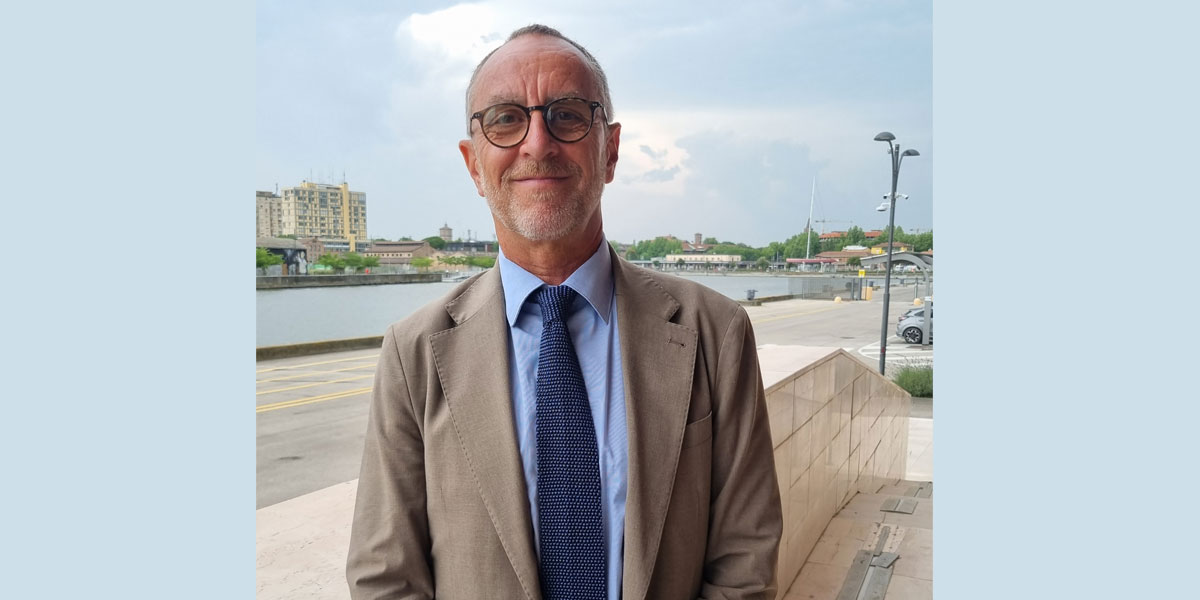
28 Oct Interview with Francesco Benevolo, Extraordinary Commissioner, Port System Authority of the Central-Northern Adriatic Sea, Port of Ravenna
You were just appointed to this role in June, 2025. Can we begin with a presentation of the Port of Ravenna and its assets and major advantages?
I began my work in mid-June but I already knew the Port of Ravenna and the surrounding area from my time at the Ministry of Infrastructure. I also served as chairman of an inspection commission on behalf of the Ministry at this port. I was struck by the quality of the work of the people and professionals I met here. There’s a strong focus on workplace safety, professionalism and effective collaboration between all institutions. I found the Port Authority to be an excellent organization, as well as a truly high-quality port community that immediately made itself available to work together in the best interests of our port.
The Port of Ravenna is implementing some very valuable projects, for which I have my predecessor to thank. Currently, the Port of Ravenna offers many opportunities to attract investment. Ours is a canal port with large, multinational companies operating along its quays. We are a leading port for the handling of steel, animal feed, building materials, ceramics, fertilizers and grains, among others.
For many products, we represent the main gateway for processed seeds that travel from Ravenna to the Po Valley, one of the most productive areas in our country. But not only is the port of Ravenna the leading national port for all the goods I’ve just listed; it’s also the sixth-largest port on Italy’s 5,000 miles of coastline. If the port of Ravenna closes, entire sections of the economy will be affected.
Another important feature of the port of Ravenna is that it is a multipurpose port, capable of handling many different types of goods, demonstrating a strong ability to adapt to changing markets. The port of Ravenna also has an important cruise terminal. The city of Ravenna and its entire territory boasts a world-class historical, cultural, touristic, artistic, environmental and culinary heritage. For this reason, Ravenna Civitas Cruise Port, a company owned by Royal Caribbean, is building a new maritime terminal of great architectural and environmental significance. The building materials are all environmentally friendly and the building’s roof features plants that retain and release heat using cutting-edge technology, which will ensure even more efficient service delivery for the ever-increasing cruise traffic our port will welcome in the future. This cruise port was relaunched in Ravenna in 2022 and in 2024 we recorded over 270,000 passengers. From 2026, with the opening of the new cruise terminal, we expect to welcome approximately 400,000 passengers to our docks annually. For years, we have been going to Hamburg for Seatrade Cruise Europe and to Miami for Seatrade Cruise Global, the most important international show for the cruise sector, where we see rising interest in Ravenna as a destination from many large companies.
We also have a significant share of nautical tourism, with 1,500 berths, sailing clubs and a very well-structured tourist reception system. In this area too, Ravenna has great investment opportunities, with land available in strategic locations. We also have a so-called “city dock”, where the sea reaches Ravenna’s historic center and there is great potential to develop tourism, hotels, recreational facilities and cultural projects.
What new opportunities may there be coming up for the port?
We have approximately 200 hectares of open space and new logistics areas available in the heart of the port, all of which is well-connected to the road and rail networks. They are also close to other docks that already handle over 26 million tons of cargo annually.
We also have a special logistics zone (SLZ) and are working to create a customs free zone. Anyone operating within these zones will be able to enjoy numerous tax benefits related to duty-free transport and storage of goods, a significant advantage given the unpredictability of current international trade policies and emerging global trends.
We are working with the President of the Emilia Romagna Region and the Mayor of Ravenna to create a regional logistics platform. This is not just a port, but a port system interconnected with a network of ports, freight terminals and airports, of which there are three in the Emilia-Romagna region. Almost all terminal operators are already served by rail tracks that reach their terminals via two heavily used rail lines on both sides of the canal. We are the second-largest Italian port in terms of annual train traffic. The goal is to reach a 30% share of intermodal transport, as required by the EU. We are committed to increasing rail traffic because it is more sustainable and efficient, reduces transportation times and costs and has clear benefits for the environment and road safety. We have a department within our port authority dedicated to sustainability, both through the application of new technologies and by emphasizing environmental protection and human safety.
We are building a cold storage facility at the cruise terminal, which will allow large ships arriving in Ravenna to turn off their engines without polluting and what makes this project truly sustainable is that the facility is powered by photovoltaic cells, providing truly clean energy.
We are also working hard towards technological innovation and digitalization. For example, we are building a 5G network along the entire port canal and are investing heavily in cybersecurity to further protect our port from potential cyber-attacks.
With all these upgrades, the port is going to be one of the most modern and advanced in Italy or even all of Europe. What would you say to international shipping companies and cruise lines about the port?
The Port of Ravenna isn’t a port that seeks prominence; it’s a port that works diligently and quietly, despite being a vital link in the country’s economy. Now is the time to give this port the recognition it deserves. But this can only be realized by networking the entire region’s infrastructure and logistics. To attract major foreign investors, we are focusing on a regional port system that can ensure effective coordination between the ports of Rimini, Cesenatico, Cervia, Porto Garibaldi and Ravenna. A port system that engages even more closely than it already does with existing integrated ports, such as those in Bologna and Parma and other infrastructure, like airports.
We already have American investment in our port and it’s clear they understand the significance of what this country is doing. I was at a large national event where both the central and regional governments were present and there were American visitors who were very interested in our business. What’s important now is to make people understand that there are great opportunities both for tourism and recreation and for logistics, production and trade. For example, there are parts of this region where an investor could implement a comprehensive, integrated tourism and recreational development project through the construction of hotels, commercial developments and student housing. Let’s not forget that Ravenna is home to the campus of the University of Bologna, the oldest university in the world.
We also have many hectares of exploitable land within the port, suitable for warehouses, production facilities, all with good rail and road connections. This could be a significant advantage to some, considering Ravenna’s location and the imminent reopening of Eastern European markets. Note that the port of Ravenna has historically been Italy’s port of entry for goods arriving from the Black Sea.
As soon as I took on this new role, I recognized the great team spirit among all the port’s stakeholders: the unions, workers, institutions and businesses. This is an ideal climate for those who want to invest, because they can be sure that everyone is working towards the success of the initiative and in the best interests of the local community. It is especially true for institutional representatives. We have a recently elected regional president and mayor and a newly appointed port authority leader. We have government projects ahead of us that will range from four to eight years. This means that opening a dialogue with this administration now guarantees continuity to anyone who wants to invest. Ravenna is a serious organization that works tirelessly, cohesively and productively to grow and consolidate, while solving problems together as they arise. It is an organization with significant, predictable investment and development potential and is moving toward more systematic, less one-off development.
How do you balance these environmental ambitions with industrial expansion, including LNG, solar and cruises?
We have established balance in Ravenna and we preserve it in every way we can. Visitors to the port of Ravenna may find themselves traveling along streets lined with port facilities and multinational industrial complexes on one side and canals disappearing into the countryside on the other, with fishermen’s huts, colonies of flamingos, ducks, swans and the house where Anita Garibaldi died. This is a landscape that inspires a bicycle ride and that demonstrates that Ravenna’s port and nature coexist perfectly. I have always been a firm believer that environmental sustainability must encompass economic and social sustainability. I am convinced that sustainability and economic development can be reconciled if we respect ourselves and tread carefully. Today, we have a highly developed weather and marine monitoring system in the port. For us, environmental care is an essential element of the port’s development.
How does the port authority support local small and medium-sized enterprises operating in logistics and trade?
The Port Authority supports those operating in the Port of Ravenna in many ways, by investing in both traffic and infrastructure networks and logistics. Improving the rail network, the depth of our port and our docks, creates more business opportunities. If the port functions well and institutions operate efficiently, businesses immediately benefit.The more smoothly traffic flows, the lower businesses’ logistics costs. In short, it’s a whole chain. Without physical,energy and digital infrastructure, there can be no development.
How would you like to invite tourists and investors? What is your final message for USA TODAY readers?
Come to Ravenna, everyone! It’s a wonderful city to visit, as well as being safe and accessible. I encourage tourists to take advantage of the many cruise lines that have included Ravenna as a stopover, some even as their home port, because of the beauty of the city and the quality of the port’s services. On the other hand, I advise investors to seize the great investment opportunities this region offers, built on strong institutional collaboration and a secure and robust job market. The Port of Ravenna, with its extraordinary geoeconomic positioning, many projects underway and its central role in Italy’s port landscape, is well positioned to see significant development in the coming years. We are open to discussions with anyone interested in serious investment projects.
Sorry, the comment form is closed at this time.