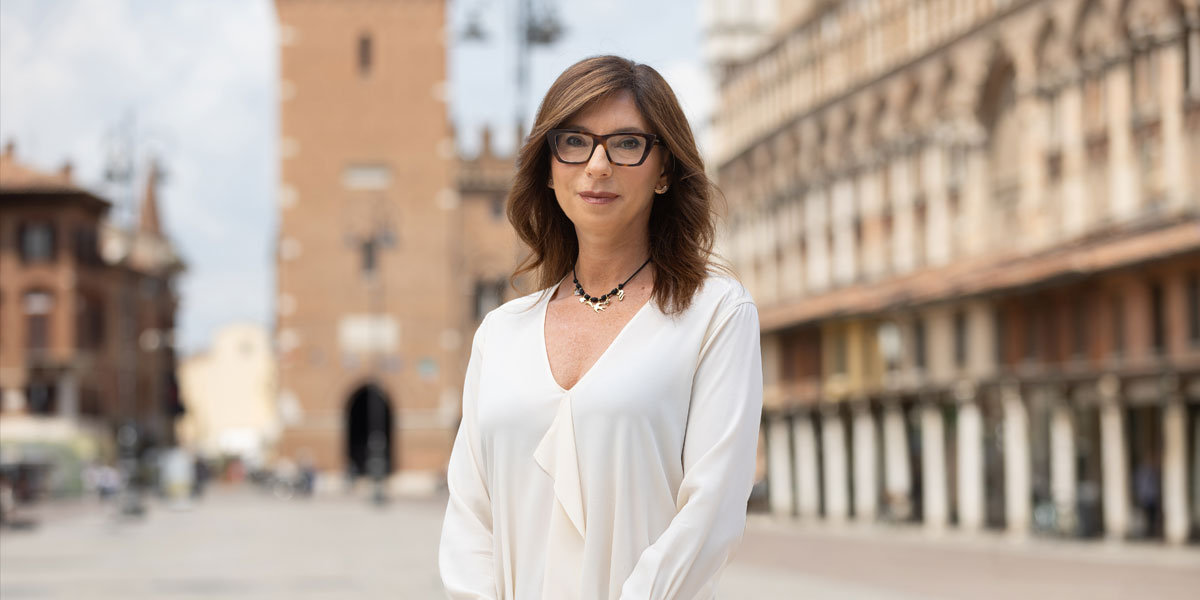
01 Nov Interview with Laura Ramaciotti, Rector, University of Ferrara
How do you see the University of Ferrara contributing to the long-term development of the city and region?
The University of Ferrara was founded in 1391 and it is not only one of the oldest universities in Europe, but it has also had an international role: it was born for general studies with the same privileges as the Universities of Paris and Bologna, two very prestigious universities in Europe at that time. Nicolaus Copernicus graduated in Canon Law at Ferrara in 1503. The story of this university is about a deep bond that unfolded and developed with the city and the region over time. For more than six centuries, the university has been growing with a very concrete and visible integration in the city. The first demonstration of this is the logistics of the university’s infrastructure and widespread campus throughout the city. We have classrooms and laboratories that are distributed both in the historical center and other strategic points around the city. They are part of the urban fabric.
The link between the University of Ferrara and the city of Ferrara goes beyond these aspects. Amongst the 130,000 inhabitants, about 30 million people such as students, students, teachers and technical and administrative staff gravitate to this area daily. Over the past ten years, the population, among other things, has grown a lot because we have gone from 16,000 to 28,000 students. The increase has promoted attractiveness and created a significant impact on the city. This clearly stimulates innovation, generates income, economic and social gains and transforms the region overall. The university institution is a pulsating heart and a strategic actor for cultural and social development. We involve the citizens in many of our initiatives from physics to theatre, classical studies, literature, economics and the entire biomedical field. Architectural heritage is a tangible example of an investment we are making to the region. We have spent about €200 million on renovations of the former municipal hippodrome that will host students in new accommodations. They will be able to live, study and have interpersonal exchanges in this place.
We have other interventions in partnership with the municipality and the Emilia-Romagna region using funding from the Ministry of University and Research. We will also create new research laboratories and new teaching halls to expand our scientific activities and we are involved in the so-called third mission, which includes all those services, initiatives, projects and events that involve the region and the citizens. For example, we have programs called Start-Upper and Greater, which have been developed together with the other universities in the region. These are paths that involve 25 start-ups offering support in the incubation phase and the acceleration of business. The aim is to journey with them in the market The Emilia-Romagna region finances these programs.
The Tecnopolo of Ferrara plays a significant role amongst research, businesses and institutions. Last year, the programs were launched within this Technopolo, which is based on four laboratories that are connected in network with other similar laboratories in the other universities of the region: Bologna, Parma, Modena and Reggio Emilia.
Last year, about 40 industrial research projects were launched within the Tecnopolo, with almost €3 million of regional funding. We are also completing the acquisition of new research infrastructures for an additional €2.6 million. In the last four years, we have invested almost €13 million in new equipment and tools to renew our technological park. We want to offer our researchers tools that are more and more at the forefront to compete in international research programs.
In 2025, we will inaugurate the first Innovation Hub of the Tecnopolo. It will be dedicated to open innovation and startup development in collaboration with the production world. The region of Emilia Romagna has been a partner for 25 years attentive to all networking themes between universities, the world of research, companies and the region. We develop projects within the system of companies and universities and the regional government, but we are open to an external perspective, not only on the regional front, but also at the international level.
The university has recently risen five positions in the Center for World University Rankings, placing 531st globally and 205th in Europe. It is also ranked among the top 500 universities worldwide for research quality. To which strategic decisions or reforms do you attribute this steady growth?
This is a significant improvement in terms of positions, being ranked 12th among the great Italian universities. However, we came third in the ranking in Italy for location. Our students graduate on average quite quickly. Above all, a higher percentage of students graduating from our university can find employment and a better job as compared to other universities. We are trying to invest a lot in quality training. This also means that we need to translate the needs of the work world into the knowledge and the skills required for our students.
From an international perspective, the activities we have done are different. The city is a UNESCO heritage site. We try to bring studies in education, training and on the regeneration of urban areas to an international level. There are many mobility and teaching programs in English. The Erasmus Plus Study program involves about 280 students every year to destinations such as Spain, France, Germany and Portugal. We also have programs such as the Tiber Umbria Comett Education Program which enable students to participate in studies abroad. We offer 22 double degrees, five of which with non-European universities such as the University of West Florida for engineering and data science. We have relaunched the ATLAS program for the United States, Canada, Brazil and Japan, after it was suspended during the pandemic.
The international dimension is central in these programs for the academic and student community. Within the regional ecosystem, we work with the Food Valley, the Motor Valley and the Data Valley. This means that we are connected to food, motorization and everything related to AI and the elaboration of large volumes of data. We collaborate and cooperate with other experts in the region to export our knowledge and skills abroad. We joined a European alliance, which is the result of EU funding for the COLOURS Alliance, (COLlaborative innOvative sUstainable Regional univerSities). We were selected by the European Commission as one of the 50 European Universities and received €14.5 million in financing over the next four years. Nine European countries are part of this network, which will work on a series of didactic research projects with a challenge-based approach. There will be strong involvement from regional stakeholders trying to share European values of inclusion, diversity and democracy in line with the sustainable development goals of 2030 and the UN Agenda.
To summarize, we started from a renaissance heritage, but with a deeply international vision. We are trying to use our university as a gateway to a highly sustainable training experience oriented in innovation. We are aware that our students have to become the leaders of tomorrow and be able to guide the digital ecological and social transition with increasingly difficult scenarios to face.
Medicine, pharmacy, science and STEM disciplines account for the highest number of graduates at the university. Many Italian universities struggle to attract students to STEM fields and attempt to encourage enrollment with post-graduation employment guarantees, but you stand out. Why do you think the university has such a strong presence in these areas?
Science, technology, engineering and math (STEM) disciplines represent not only the present, but also the future in terms of cultural and socio-economic dimensions for Italy, Europe and at an international level. The technological transitions that we are experiencing provide a base to make a strong and massive use of data and data elaboration. This is also about a frontier of technologies in various fields such as ecology, sustainability, food, health and renewable energies. We are trying to encourage students to study in these disciplines so they are able to share, both scientifically and professionally, knowledge and skills about new technologies, big data and automation.
In 2023, we established an interdepartmental master’s degree in AI, data science and big data. This is a collaboration between our Department of Computer Mathematics and the Department of Engineering. Last week, the first two students of this new avant-garde course graduated. They started the program in July 2023. We have other programs such as the Advanced School in Artificial Intelligence, which is in its second edition, funded by the Emilia-Romagna region. It trains young graduates on the most advanced AI technologies, with a very practical and flexible approach, in close collaboration with local companies. AI seems to be more and more present across all areas of study, such as in medicine and biotechnology, for example, therefore, it is a fundamental tool for analyzing complex data, such as biochemical tests and radiology images. We have integrated AI teaching in various study courses to go beyond the confines of computer science. We are planning a new degree course in digital communication, which will be ready in 2026-2027. The program will prepare students to use these technologies with awareness, always valuing critical and creative thinking.
In 2022-2023, more than 63% of our enrolled students in STEM courses were women, a figure higher than the national and even European average. Closely working with the region in collaboration with schools, associations and companies, we were able to break down those stereotypes and build more trust and positive models of approach to scientific disciplines. We are trying to carry out a deep cultural change while we support our students, stimulating a bit of ambition in contexts that are culturally seen as more masculine. In medicine, pharmacy and pharmacology, the female presence is just as strong.
Moreover, we have ensured quality, academic and professional environments are increasingly inclusive. We are also trying to address the theme of the female presence in science with equity and a lever of innovation. This is happening through active policies that give concrete opportunities and build successful stories for our researchers and for our students.
With 15 PhD programs, 400 doctoral candidates, and over 30 postgraduate specialization schools, the University of Ferrara stands out as one of the most advanced research institutions in Italy. In this context, what is your final message to the millions of USA Today readers?
We are investing a lot in the doctorate even though the Italian industrial sector does not yet highly value it. In many European countries, a young person who graduates from a doctoral course has access to more senior leadership roles. This may also include a higher salary level than if he simply obtained a degree. In Italy, this differentiation still does not exist. However, we believe that we need to remain competitive, dynamic and aggressive at the national and international levels. We need to offer our young people the maximum knowledge and competences.
In light of that, we have made many investments to increase the doctoral scholarships, some of which are under the financing of the National Plan for Recovery and Resilience. This means importing young people perhaps more or better trained from other European countries. We hope that they are interested in pursuing their path of study and research in the academic field. They may become entrepreneurs themselves and use their knowledge and skills in the future.
There is a huge need for entrepreneurial exchange from a demographic perspective. In the coming years, Italy will have fewer young people facing the work world. This will also result in a problem of denaturalization for the university system. We can also call this a problem of entrepreneurial exchange of entrepreneurial fabric. We need to make sure that our students leave the university courses with a maximum of skills and knowledge to know how to master and guarantee survival of the species.
The final message is that knowledge and competence are the basis of any personal and collective growth path. Without these, there can be no development, no progress and no social dynamics. I believe that our young people must have a mission to seek the enrichment of knowledge and competence not only in the university setting but also in their everyday life.
Sorry, the comment form is closed at this time.