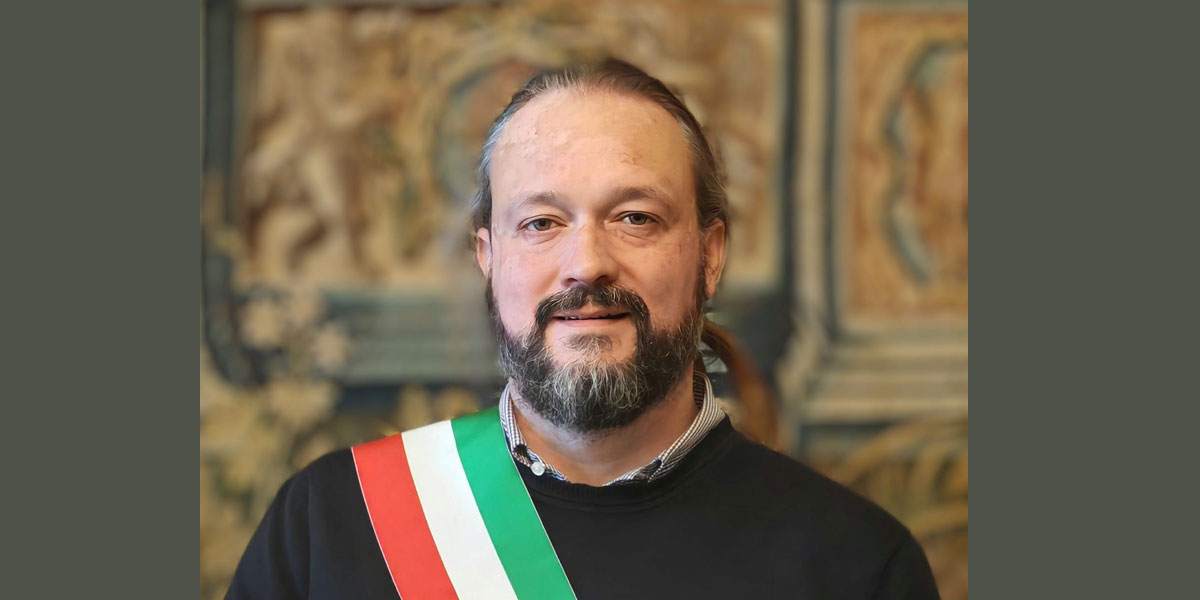
12 Nov Interview with Alan Fabbri, Mayor of Ferrara
You were re-elected in 2024 with a comfortable majority. What are the main reasons for this and what do you intend to do with your new mandate?
I am the first center-right mayor elected in the postwar era. When we started in 2019, it was a real gamble. I worked hard not to disappoint those who had voted for me, but also to make it clear through my actions that I was not an enemy of the city. I believe the citizens understood this: they saw everything that had been achieved, even during the difficult COVID-19 years.
In 2024, I won the election again, with 58% of the vote. In the Civic List alone, I reached 30%; an incredible number, unthinkable until just a few years ago. On the same day, voting was held for the European elections, in which the center-right took 46%. It’s a mathematical fact: part of those who voted Democratic Party in the European elections voted for me in the local elections. As an engineer, I feel that good intentions matter less than statistics, which show that millions of euros from Europe and Italy are being reinvested to improve services and infrastructure without burdening municipal finances.
Ferrara is now more beautiful, more accessible, livelier and safer. We’ve also worked hard on our pride and sense of belonging. We live in the beautiful cradle of the Italian Renaissance; a city protected as a World Heritage Site by UNESCO. I think that’s something to be proud of, but there is always room for improvement. My approach is to keep striving, especially given the extraordinary results achieved so far. This is why we are continuing what we have started: now that we have made Ferrara proud by working on infrastructure, restoration and the “container”, the goal now is to work on the “content,” making it attractive to the outside world in terms of tourism, the economy, and jobs.
What is your previous experience in Bondeno and how it helped shape the kind of leader you are today?
This is my fourth term as mayor. Before arriving in Ferrara, I served two terms as mayor of my hometown, Bondeno, a city in Ferrara province that was severely and tragically hit by the 2012 Emilia earthquake. Such a profound, unexpected calamity brought death and destruction. It was necessary to respond immediately and so I did, managing those terrible days and the reconstruction that followed. This dramatic experience taught me the value of community and the spirit of initiative that are so typical of our region. Connecting with displaced people who had lost everything overnight broke down every barrier. There were no politicians and citizens; just a community trying to get back on its feet. This taught me how important it is to connect with people and to understand their real needs beyond the political process.
How are you growing tourism in beautiful Ferrara without encouraging mass tourism, as seen in other Italian cities?
Tourism is one of my passions. Ferrara is a unique city that can still grow and develop without losing its identity and beauty. We have been investing in that vision, and the results are beginning to show. They are unprecedented for our city. Ferrara is now a very different place, with a robust and varied economy. A lot of work has been done on public works to make the city more livable; first and foremost for residents and then for tourists. Ferrara, by its very nature, is a city on a human scale: everything is reachable on foot or by bicycle. We’re working on the quality, diversification and promotion of our offerings to enhance tourism.
For me, concerts and culture are not just a passion, but an essential economic driver for Ferrara. Since 2019, we’ve tried to make the city more vibrant and I think we’ve succeeded. Ferrara was just as beautiful, if a bit sleepy. But there wasn’t a yearly program that could cater to a wide range of audiences, from families to university students, of which Ferrara’s historic university has around 30,000.
We’ve also worked on events, redeveloping previously abandoned spaces like the water-front Darsena area, which is beside the historic center and now hosts events and concerts. There are restaurants and in the summer, events for up to 20,000 people. We know we’re in a protected city, so we’ve always complied with all regulations, in collaboration with the government.
In 2023, we hosted a 50,000-person Bruce Springsteen concert in the Urban Park. This was a first for Ferrara, and the event generated over €10.3 million in revenue for the local area, according to a study by Unife. It was a fantastic experience. We assembled a team of industry professionals to create mega events. The next one will be on June 5-6, 2026, featuring Vasco Rossi, the greatest Italian rock star of all time, who is launching his tour from Ferrara and100,000 people are expected. It will be another huge organizational challenge for Ferrara: I believe our city is becoming a model for other communities around us as well.
What is the role of economic revitalization and the private sector in job creation?
Ferrara was long deliberately excluded from regional policies and investments. So we started from scratch during the pandemic, working on a project we called “Ferrara Rinasce”. We worked to make the city prouder and to insert ourselves into decision-making circles. The goal is to invest and encourage even more investment in Ferrara. We have now been included for the first time in the Simplified Logistics Zone which will have significant implications for local businesses and companies.
Ours is a predominantly agricultural area, so we created the Ferrara Agriculture System to unite the municipality, trade associations, and local companies. We involved the university and the Ferrara Industrial and Technological Center, which is among the three main production sites in the chemical sector in Italy. It extends over 250 hectares and hosts nine companies, three of which are multinationals with nearly 2500 employees. The theme of work is central: last year we organized Ferrara Work on Work, the first fair in Italy about work, where demand meets supply, open to companies and jobseekers alike.
Can you share more information about Ferrara’s hydrogen bus initiative and your environmental vision?
Our hydrogen buses are unique in Italy. Currently, only the city of Bolzano, which is part of a special-statute region, has a hydrogen distribution plant with a capacity similar to Ferrara’s. This is an innovative, completely eco-friendly refueling system. In addition to having zero environmental impact, as electric vehicles, these buses also guarantee greater range: on a full tank, our buses can travel up to 250 miles.
I was born in the Ferrara countryside and environmentalism has always played a key role in my political platform. Last year, we launched a €43 billion green plan to reuse industrial water at a local petrochemical plant, which is reducing water consumption from the Po River by 53%. The project is part of a broader enhancement of Ferrara’s industrial and technological hub, focusing on ecological transition and energy efficiency.
Another project is to make squares and public spaces greener to reduce heat islands. We are also working to create a new urban park, the second largest in the city, which will connect the eastern part of the city to the historic center. We are talking about a total area of approximately 55,000 square meters, which will become an oasis of tranquility, a green corridor for residents and will be able to collect rainfall, thereby reducing the risk of flooding that often affects the neighborhood. We are also extending our bike paths, because the bicycle is the preferred means of transport in Ferrara.
What is your final message to our readers?
I urge young people to take an interest in politics and get involved with humility and a desire to understand. I started serving on the city council at 19, while I was attending university. In my spare time, I played bass in a band. I graduated and then worked on the family farm and later as an engineer. I became a councilor for the first time in 2006, at the age of 25. All this to say that it can be done and it’s an experience I recommend to everyone, especially the younger generations.
Sorry, the comment form is closed at this time.