
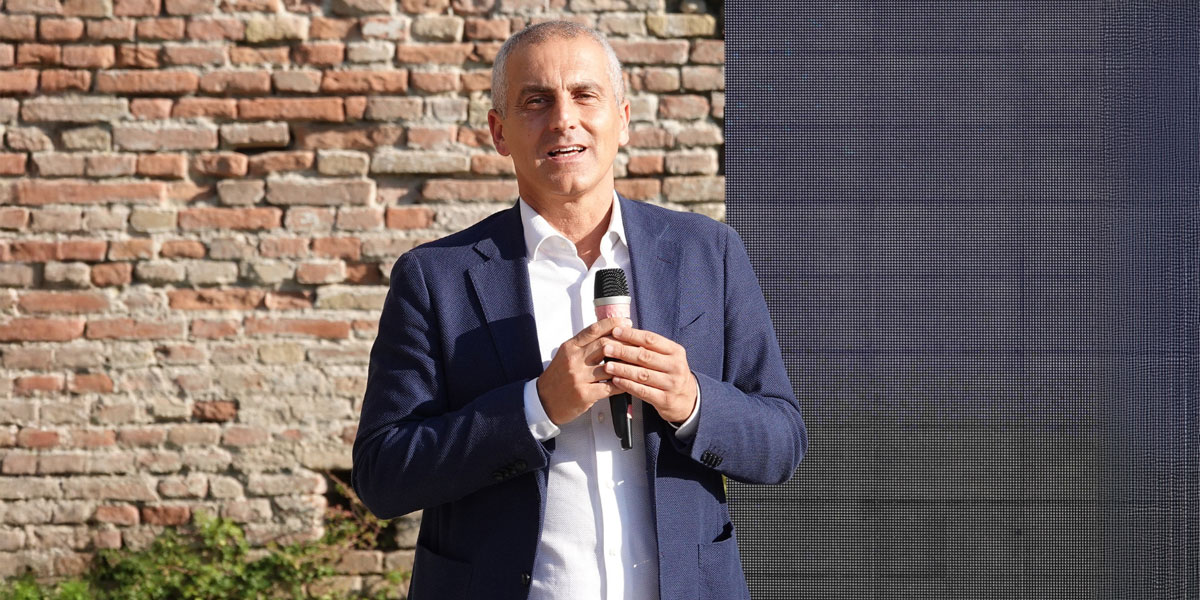
13 Nov Interview with Jamil Sadegholvaad, Mayor of Rimini
In recent years, Rimini has undergone a widely praised urban transformation, with public spaces restored and designed to better serve both residents and tourists. In your opinion, what has been the most significant success of Rimini’s urban regeneration strategy so far and which have had the most noticeable effect on the quality of local life?
Our main strategy has been to support and promote quality tourism. Quality is the focus of this operation. It is comprehensive, widespread, environmental, urban and social. We want to be the point of reference as a touristic location in the Mediterranean area. Our two main directions have been on the regeneration and redevelopment of the historical center and the waterfront. In terms of the historical center, we have to pay attention to the Roman origins, such as the Tiber Bridge and the Arc of Augustus. We have seen more tourists in this area both in the summer and throughout the year, thanks to major investments.
The seafront area has seen eight miles of redevelopment. Previously, it was a road with cars. It has been transformed into a pedestrian area, which includes a livable space for residents and tourists with sports activities, social activities, children’s playgrounds, wellness areas and meeting places. This plan is for Rimini to be a city that greets people 12 months of the year. Rimini has always been known for its beach tourism, therefore, linked to summer fun at the beach and seafront area. The city actually is alive all year round due to its trade fairs and congresses. Cultural tourism is intensifying the flow to our city.
Rimini’s connection to Federico Fellini has been celebrated with the opening of the Fellini Museum, a cultural project that has expanded the city beyond its seaside identity, establishing it also as a center for art and cinema. What impact has the Fellini Museum had on Rimini’s cultural prestige and international visibility?
Rimini has a close connection with Federico Fellini, who was born here in 1920. He created some of his most famous films in Rimini, including Amarcord, which won him an Oscar in 1975. This deep relationship between Fellini and Rimini deserved to be celebrated with the only museum in the world entirely dedicated to this great director. The Fellini Museum was inaugurated in 2021. The Ministry of Culture recognized the museum as one of the most important national projects worthy of public funding and approved the initiative. The museum extends across Castel Sismondo, our city’s castle, to the Palazzo del Fulgor and Piazza Malatesta. Today, visitors and tour groups explore these three sites year-round. We are pleased that Rimini and the museum are gaining international attention.
Broadly, your administration has strongly promoted sustainable mobility, with investments in electric buses, bike lanes and green corridors. How do you assess the success of the transition toward sustainable mobility in Rimini and what milestones have already been achieved in terms of emission reduction or public transport usage?
This is one of the main challenges for Rimini’s strategic plan. Many associations have been working on the design of this plan. We are now turning this into a reality for our city. Our idea is for a sustainable city, where many cement and asphalt spaces are transformed into spaces for social activities and living and moving in a safe and sustainable way with bicycles and scooters. Based on data from the scooter company, Lime, Rimini is one of the first three cities in Italy to offer scooters to tourists. They can move freely along this vast seafront with their scooter.
We would like everyone who arrives in Rimini by car or plane to have the opportunity to move around the city with sustainable means such as a bicycle. The seafront is a metropolitan area connecting Rimini with Riccione. It will be extended to the Rimini fairgrounds. Our aim is to have tourists move around the city without a car, enjoying an ecological way of living.
Rimini acts as a hub for the region and for San Marino. How well connected is Rimini for international visitors?
Rimini is connected to London with Ryanair and EasyJet flights and British Airways through Heathrow. As an international hub, Heathrow connects to the world. This new flight from British Airways is already operational and is bringing us results in terms of international tourism. Previously, they arrived at the Bologna airport. The Grand Hotel of Rimini is a historic hotel, considered a national monument. Federico Fellini stayed for long periods in this hotel. Americans were the first tourists to stay in the Grand Hotel. When a tourist from the US arrives in Rimini, he is immersed in an extraordinary dimension of history, culture, art, cinema and the sea in one beautiful city.
San Marino, less than 10 miles from Rimini, is one of the oldest republics in the world. I think it is amazing that someone can travel to this beautiful and historical state while visiting Rimini. In San Marino, the Italian language is also spoken.
What role does digital innovation play in your future vision for Rimini and can you share some technological solutions recently implemented in public services?
This is our challenge for the present and the future. I think this is a worldwide issue for most cities. Rimini has done a lot in terms of digital services. Just a few days ago, we introduced the Rimini City Pass. Obviously, the City Pass is not a novelty. It is a fully digitized city pass with a QR code enabling access to the buses, to economic activities, museums and more through a cell phone. This successful project provides a better service to tourists.
What are some recent examples of how Rimini is becoming a more inclusive and equitable city, addressing challenges related to housing or educational inequalities?
Social inclusion is an obsession for us. We have always seen tourism as a tool for social democracy. After World War II, Rimini became a place that enabled all Italians, regardless of their economic conditions or wealth, to go on vacation. For example, we would see Gianni Agnelli, chairman of FIAT, and the FIAT workers on vacation. We have always had a wide range of hotels from the five-star to the more popular options.
This year, we created free beaches called the beach for everyone because it enables women, men, boys and girls, despite any disability, to spend time on the beach and the seafront rather than sitting in their car. We have received many letters from parents praising us for this opportunity to open the beach to those who could not come before. We believe that this was an important decision because everyone has the right to take a vacation.
Having led the city through a period of profound transformation, you have helped shape a modern vision of Rimini. Your leadership style has been praised for its ambition and forward-thinking approach. With that in mind, what is your final message to the readers of USA Today?
We invite everyone to come and discover Rimini and the Emilia-Romagna region. I believe there are many beautiful places in the world, but Rimini stands out because it offers everything. We have the sea, history, art, stunning valleys, bike tourism and inclusive vacations that are accessible even to those with physical disabilities. Rimini provides the opportunity for a truly enriching holiday, especially when it comes to our outstanding gastronomy and wines. Today, travelers are looking for experiential tourism, not a packaged resort experience. Rimini is the ideal place to enjoy an experiential vacation that blends the sea, art, culture, nature, the environment and exceptional cuisine.
Sorry, the comment form is closed at this time.