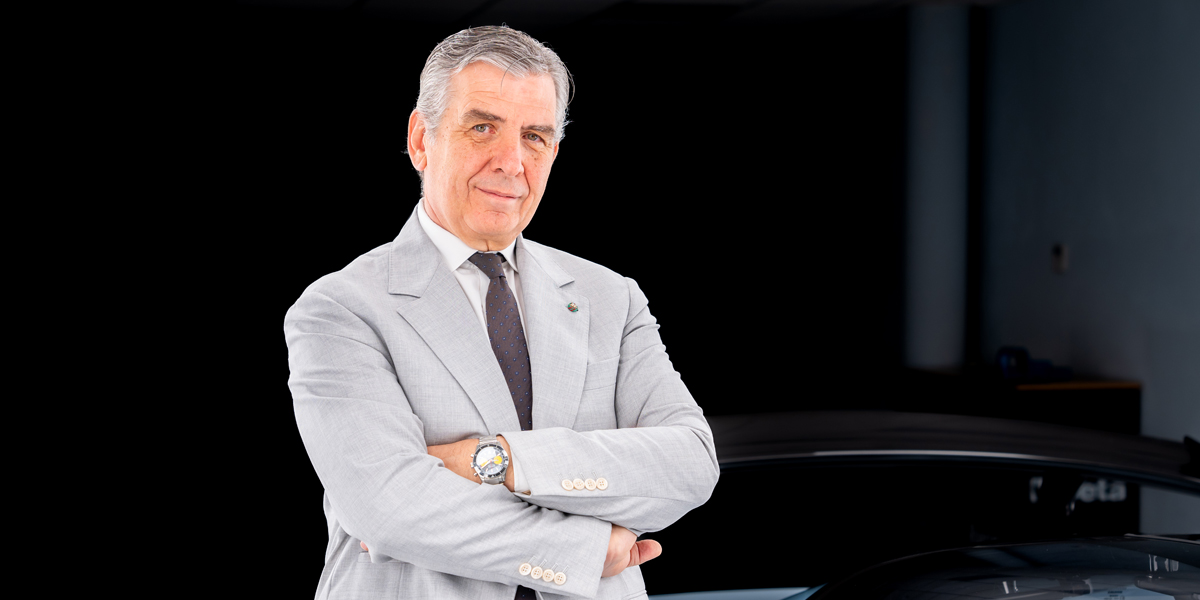
09 Nov Interview with Andrea Pontremoli, President for Motor Valley Development Emilia-Romagna, Italy
Emilia-Romagna stands out for its exceptional automotive legacy, proudly hosting iconic manufacturers such as Ferrari, Lamborghini, Pagani, Ducati, Maserati and Dallara. How did the automotive industry develop its unique identity and what are the main strengths and economic contributions of this sector to the region today?
I was appointed president of Motor Valley Development four months ago. Since then, I have been working to fully understand what Motor Valley really is. People know the iconic brands, but behind them there is a network of over 15,000 companies generating €133 billion in business. We recently completed a study listing every one of these companies — from major players to small firms of 10 or 20 people — each a leader in its niche. For example, if you want the best titanium screws, you go to Poggipolini in Bologna; for top exhaust systems, DTS in Maranello is the reference. This ecosystem is spread not only across Emilia-Romagna, but also into Piedmont, Lombardy and Veneto.
Many key partners like Pirelli and Brembo, based in Lombardy, supply world-class components to companies here. It’s truly a unique industrial system. My goal as president is to shift from an egosystem to an ecosystem — to work together. We started with education. Alongside all the major brands, we launched the Motorvehicle University, bringing together the universities of Bologna, Modena and Reggio Emilia, Parma and Ferrara. Together, we have designed nine new master’s programs in fields like racing car design, supercars, electric and autonomous vehicles and superbikes — specialties that didn’t exist before but are exactly what we need for the future. The program has already attracted students from around the world and we are especially keen to welcome more Americans.
Three weeks ago, we strengthened ties with Purdue University in Indianapolis to exchange students and knowledge. If you want to study motorsport, superbikes or supercars, Italy — with its iconic brands and deep expertise — is the place to be. We have already launched joint research projects and plan to expand them further.
Motor Valley began as a tourist destination, but now enthusiasts want to see where and how our products are made — and experience the lifestyle here. The beauty of this region is that our companies, though sometimes competitors, work together as friends. Their real competition is outside Italy. Here, we cooperate to build our future — that is the true spirit and essence of Motor Valley.
What have been the key milestones in Motor Valley Development’s journey and how do these achievements shape the organization’s mission today?
Our priority is to shape our own future because the best way to understand it is to create it. We started with education: Motorvehicle University of Emilia-Romagna (Muner) is a non-profit that offers advanced degrees, but we also created Innovation Farm to train skilled technicians, like mechanics and carbon-fiber specialists. To inspire young students, we run Formula One in Schools for ages 10 to 16, where teams design, build and race small F1 cars, learning that competition drives improvement.
After university, we offer specialized master’s programs in areas like aerodynamics, vehicle dynamics, carbon fiber and high-performance engines. We also have an international MBA in motorsport and supercars at Bologna Business School to train future managers for this industry. All these non-profit initiatives share one goal: to design and build our future together. This is all part of a social system where we also enjoy life together — good nightlife, shared fun — which is exactly what our visitors want to experience.
Last year, Motor Valley attracted 2.65 million visitors — 850,000 at the Ferrari Museum alone with 54% coming from abroad. Our companies have redesigned their factories to welcome tourists. Many have museums or academies showing how we work and what we create. Altogether, we have six brands, four racetracks, 15 museums, 19 private collections open to the public and 188 motorsport teams. It’s our way of sharing what we do and who we are.
All this is amplified by our racetracks, which are huge marketing platforms. Imola hosts Formula One for cars and Misano hosts MotoGP for bikes — both in Emilia-Romagna and attracting global attention. Another growing area is ‘gentleman drivers’ — people who buy these amazing cars and want to drive them fast on proper tracks. Our many racetracks make this possible and create more business around hotels, restaurants, and services. This kind of experiential tourism is growing quickly — people come not just to see, but to feel the thrill themselves.
The Motor Valley Fest has become a crucial platform to explore the future of mobility. In your view, how does this event contribute to positioning Emilia-Romagna at the forefront of new mobility solutions with innovation, sustainability and skill development meeting tomorrow’s challenges?
This four-day event is very important for us. It brings together the CEOs of Motor Valley brands to discuss the future of cars and motorcycles. This year, we had 40 events and over 200 expert speakers covering topics like AI, new engines, future mobility, autonomous vehicles and more. It’s also a chance to highlight our research, like the Motor Valley Accelerator — a non-profit supported by companies and government, now nurturing 45 startups that connect with our established brands and universities.
During these days, the world’s most beautiful cars gather in one city. Thanks to chef Massimo Bottura — named the best chef in the world — we share our local food traditions too. Every Friday, he hosts our speakers with the best of Emilia-Romagna: Parmesan, prosciutto and more.
The automotive sector leads Emilia-Romagna’s exports to the USA, with nearly €3.3 billion in trade, making it a vital market for the region. How does Motor Valley Development position itself to attract American investors and foster strategic partnerships? What kinds of collaborations between Emilia-Romagna’s motor companies and US investors are you aiming to promote?
For this network of companies, Motor Valley plays three roles: a marketing tool to showcase our excellence, an education hub and a driver of research through startups and labs. For example, Europe’s largest supercomputer is in Bologna and available to our companies — a great resource for anyone wanting to invest in the future.
Motorsport, supercars and superbikes are the fastest-growing segments in automotive, so attracting outside investors is crucial to keep up with global demand. Everything here is connected, from Muner to the Cineca supercomputer, led by Francesco Ubertini, who was also behind our university’s launch. We work together as friends with one goal: to shape our own future and set trends for the industry.
The US has tremendous digital expertise and strong investment capacity — exactly what we need here. We know what we want to do and how to do it, but we need these digital tools and resources to apply them to our industry. The US is also our biggest market, so it’s the perfect bridge to combine our know-how with their technology and capital.
How do you see Emilia-Romagna’s automotive and motorcycle industries evolving over the coming years?
We are heading in the right direction by linking the real and virtual worlds. The eSports and video game sectors are growing fast, but they need real-world testing — and here in Motor Valley, we have both. Motor Valley is a lifestyle we can share globally. For example, in the US near our Indianapolis office and the famous racetrack, people see that we have what others only dream of — so why not connect and grow together?
What is your final message to our American investors and business leaders about choosing Emilia-Romagna as their next travel and investment destination?
I spent 27 years at IBM, an American company where I grew professionally and became president and CEO for South Europe, managing 25,000 people. Then I left to join Dallara, which grew from 100 to 900 employees. I am grateful to IBM and America for teaching me the skills I use today. Now, I want to give back — both to America and to my home region. To be competitive globally, you must first make your own territory competitive, because no one succeeds alone.
Sorry, the comment form is closed at this time.